Showing posts with label American literature. Show all posts

Saturday, May 10, 2014

Departures: Memoirs. By Paul Zweig.

"I've never been much good at transitions. Over the years, I have gone as if expelled, dragged or broken from one life to another, never quite willing or knowing. It has been all zigzags, changes that sprang from nowhere and became irreversible, as if I had been shunted onto another plane of life, never choosing and never prepared."
Paul Zweig is a Jew born in America, a little after WWII. Already as a child, he doesn't consider himself as a 'real American' neither as a 'real Jew.' All his life will be spent in this quest of his self, and for that matter, he will voyage through the earth to find out who he really is.

 Paul Zweig. Dead in 1984.

Departures: Memoirs is in part a rewriting of one of his earlier novel named Three Journeys, and a memoir of his life spent in departures. Against all odds, Zweig is writing on his death's bed for is relatives, especially for his daughter, but as readers, we could have think that he would have been more modest in his writing; instead, the readers can sense the fertility, the sexuality of Paris has never we can sense it now. An enormous part of his memoirs is about sex, his penis and his loneliness. 
"But an anxious solitude possessed me. I felt numb, alone with my lanky thighs, my belly that was already a little domed, my chest hairs and my clotted curls of public hair; alone with my penis that had retracted and become insignificant, like one of those marginal outcast boys with fat unhealthy faces in my classes in elementary school."
What is really interesting about Zweig is his ability to throw all his self in his quest of the French language:
"I decided that I was going to read all of French literature, starting at the beginning."
And the reader can feel his difficulties, that he finishes to overcome language, and masters it: winning the battle, becoming the other. His memoirs are truly the immersion of an expatriate man, in the mid-1950s to the mid-1960s, who senses he never has a homeland.

The second interesting fact about this book is Zweig's implication in the Algerian war. I will not say much about that, because I would like you to read all his nostalgia about life and death, about the known and the unknown, love and hate, peace and war. The last chapter made me wept... This is just to say that this book's worth reading.


Recommended if you love memoirs and if you are interested to know more about France in the mid-1950s.

Wednesday, May 7, 2014

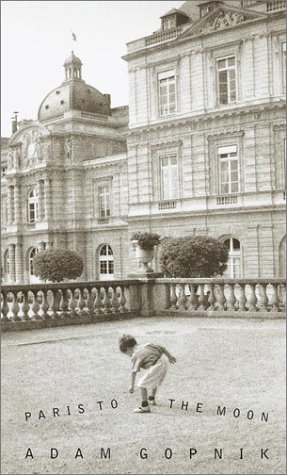
Paris to the Moon

Hi you all, darlings of my life!

I've just finish my school semester and this is a total relief. The two last books I've just read were amazing. So, I'll start with one of them and you'll know the other on Sunday. I want to post more regularly now: let's say at each three or four days.


"The differences are tiny and real. Cultures don't really encode things. They include things, and leave things out."
Adam Gopnik has a highly reputation as a journalist of the New Yorker. In 1995, his first child was born in New York, and his wife and him decided that they want to live in Paris in order that their child can have a beautiful existence. The premise is strange. What weird parents would do a thing like that to their child: expatriate him from his family and friends before he can even know them! But whatever, I enjoyed the book. From Paris, during five years, Gopnik will write a column in the New Yorker about topics of his life in France. Paris to the Moon is a compilations of those reports, with four more never handed, and a first chapter (titled as the book) that has been written after.

Gopnik.

It sure is a first narrator who completely knows where he comes from, what he is doing, why he is doing it, and where he will go. What is strange about this book is that even if the narrator is a complete American with his capitalist view of the world and his touristic ways to do things outside his country, he is so full of love for his child, for his wife, for life in itself that it is really difficult to not like his writing. In fact... he is so cheesy. Two examples:

The first is when one of his friend (back in New York, on one of Gopnik visits for Christmas times) asks him why they lives in Paris, Gopnik writes:
"So, Paris. 'We want him [his child] to grow up someplace where everything he sees is beautiful,' we said, and though we realized that the moment our backs were turned our friends' eyes were rolling, we didn't care. We knew that our attempt to insist on a particular set of pleasures for our kid−to impose on our child−might be silly or inappropriate or even doomed. We couldn't help it, entirely. The romance of your child's childhood may be the last romance you can give up."
Isn't it cheesy? Is it gonna work? I mean, is his kid gonna like his life in Paris? Will he take Paris as his home? Or New York? Grown-up, will he find it as romanced as his father had?

The second is that through out his writing he tries to put words on how his country is seen in France and why, but even if he do sees the truth behind some assertions, he just can't bear it. So, to sublime it maybe, he'll gonna transform it in fictions such as comparing Americanism with a T. rex.

Okay, maybe I'm psychoanalyzing Gopnik a little too much, but one thing is sure: this book is refreshing, funny, silly sometimes, but oh-how-really-humane. Even if his aristocratic life deludes him on some aspects of Paris, he nevertheless expresses the will of human being to overcome differences and to enjoy life together.

Paris to the Moon's graphical view given in the book.

I like the way his wife presents their return in New York, concluding the book on a kind of reflexion about what exactly home should be:
"We have a beautiful existence in Paris, but not a full life," Martha said, summing it up, "and in New York, we have a beautiful life and an unbeautiful existence."
Weirdly, I think they're right. You can have only two choices in life: one is to stay right where you are and feel the love and the needs of the ones whom are important for you, the other is to fly where wind brings you, discover and keep on learning about the beauty of diversity. The first one is the easy choice; the second is the difficult controversial one, but that's the one where romance takes place. What do you think?

Just another silly, but so cute moment in his child's childhood in Paris.

Recommended if you want to see Paris through the eyes of an American, if you have a great sense of humor, and if you want to truly know some differences between two cultures that have been at the top of the international economy.

Don't be shy: write a comment! I need to know how you like this post and this blog. Have you read this book? If yes, what were your feelings about it? If not, would you like to?


Thursday, April 3, 2014

Manhattan Transfer

"Opportunity knocks but once at a young man's door."
What a pessimistic quote, you would say. And you would be right 'cause I just past three horrible weeks reading Manhattan Transfer, a novel by the famous American writer John Dos Passos. I thought I have to write something down to get it set up in my mind, because my student life is so awful right now, I can't even think fully and wholly of one goddamn subject without immediately thinking of something else. And this book doesn't help me to get my mind fixed up! Oh no!


Completely glaucous, the book tries to embody to much things at the same time with an experimental genre where Dos Passos uses a narrative collage technique. My university teacher says it is inspire by cubism. I thought cubism was much more profound then that... In literature, it seems that all perspectives are mixed up, sometimes carefully too much exaggerated and others, not enough as it should be.

The novel, published in 1925, focuses on the life in New York city between an age of prosperity (the Gilded Age) and one of economic decadence after the WWI (the Jazz Age). There's many characters, many plots, a succession of events, and sometimes simultaneously. The problem with that nonlinear narrative is that if you love, as a reader, to associate with one character, it's quite impossible. I just almost succeed to love two of them, which are Ellen and Jimmy. And you will have to read the book to understand why I didn't succeed to be totally fond of them 'cause I don't want to give away to much punches.

When we first met Ellen, she's a little baby. Even if her mother is crazy, her father is a successful businessman who takes care of them. What is truly amazing about her is her ability, as a young woman, to define herself by her art (she's an actress) and not through out the eyes of men.
Jimmy is completely is opposite, I think. Fatherless, his mother dies of a stroke when he is an adolescent. He's raised by his aunt and uncle, but he rebels against the system of financial success in place and turns to journalism to denounce capitalism. He's completely in love with Ellen, but like none of us he can't compete with a "perfect" dead lover.

In the major themes addressed, you have all sense the one of the mean American capitalism. John Dos Passos, in 1925, was a fervent leftist. However, like all (or almost) any human being who becomes successful, he completely changed his rifle edge in his last years. Well, here is some quotes I thought that were really beautiful about his view of the American society at this time:
"But I don't think a flourishing businessman is the highest ideal of human endeavor."
"The more educated a feller is the more use he is to his class." 
"Well perhaps you can tell me why in this country nobody ever does anything. Nobody ever writes any music or starts any revolutions or falls in love. All anybody ever does is to get drunk and tell smutty stories. I think it's disgusting. . . ."


Most of the characters presents in the interminable list of this book have also another goal than financial success, which is to be love and love in return. My favorite part of the book is when Jimmy encounters a guy named Bullock. They are walking outside, both drunk, when Bullock says to Jimmy how badly he wants to die 'cause he can't like women. Jimmy will clear the subject, obviously uncomfortable, by giving him the advice to go to a psychoanalyst. This part touches me by the way it embodies, in 1925 (don't we dare forget it) the horrible situation in which LGBT peoples cannot named themselves and were considered mentally ill. 

So, that was a dreadful everlasting novel, but how inspiring it is, now that I took the time to set it straight up in my mind. I will let you with another quote:
"There are lives to be lived if only you didn't care. Care for what, for what; the opinion of mankind, money, success, hotel lobbies, health, umbrellas, Uneeda biscuits . . . ? It's like a busted mechanical toy the way my mind goes brrr all the time."
Food for thought, uh? What are you caring about that is not as important as you sometimes think it is?