Thursday, April 17, 2014

Loon Lake

"They'll work at a job and not know why. They'll marry a woman and not know why. They'll go to their graves and not know why. . . . I've never understood it, but there it is. I've never understood how a man could give up his life, give it up, moment by moment, even as he lives it, give it up from the second he's born. But there it is. Bow his head. Agree. Go along. Do what everyone's doing. Let it leach away. Sign it away. Drink it away. Sleep it away."

I have so much things to say about this novel... This is insane.

First, I'll introduce you to its author, because he's worth it (the proof is that his work has been published in thirty languages!). Born in 1931, he's not dead yet, and he's been a prolific writer on a unique work: historical fiction. E.L. Doctorow thinks that America lacks of historical substance that normally gives opportunity in literature to work on as a writer (in its interpretation, reinterpretation, and invention). Among others, Doctorow wrote Ragtime, The Book of Daniel, Lives of the Poets, and Welcome to Hard Times. Doctorow was at first an editor, but he left publishing in order to write.


Loon Lake was written in 1980, but situates its narrative around the Great Depression. The postmodernist novel intermixes three different genres (bildungsroman, picaresque, and proletarian) in addition to mix up poems in a nonlinear narrative switching from the first to the third point of view and between two characters. Poems are mostly notes on Warren's life, and people he encounters. What is more destabilizing is the technique of stream of consciousness that is everywhere.

"I had the uncanny feeling that he was translating what I told him into another language."

When I started reading Loon Lake, I was overwhelmed by all these layers. I checked out the reviews, and was stunned by all the bad critics. However, I keep going (I had to read it for an university class), and I forgot to sleep one night, too caught up in the story. Joe is a hobo born in a poor family, as most of the characters are (Warren, Clara, Sandy, Libby). He quits his parents to live where life brings him. At a certain point, he is attacked by savage dogs on a propriety of a millionaire where he will encounter whom he seems to think is the love of his life, Clara. However, he has to take her out of this estate, because she is the propriety of Tommy Crapo, an awful and prosperous gangster (who will return there soon), and Warren (who lives there too) is also completely in love with her.

"But how she felt was overriding importance to me, how she felt!—then and every moment after—was my foremost concern, what I lived by."

The self-conscious narrative about one or the other narrator brings me up to be skeptic about their reliability, mainly about Joe. Is he telling the whole truth or is he making it all up like he is doing with the cops?

"You are thinking this is a dream. It is no dream. It is the account in helpless linear translation of the unending love of our simultaneous but disynchrous lives."

The end is so unexpected that I cannot even put words on it. All that the reader can have expected is swept aside.

The way the novel mixes high and low art, fiction and non-fiction, literary genres, dissolving love and hate, aggressiveness and sweetness, amorality and morality (...) makes me fall in love with it, but also with E.L. Doctorow. This author is a genius! Finally, all the narrative is based on one excellent question of life: which is more important than the other: freedom or material wealth? At the beginning, Joe thinks they are incompatible. Will you be willing to hear his conclusion?

I recommend you Loon Lake if you are willing to live an extraordinary adventure of experiences with literature, if you like to be surprise, and if you want to transcend the need of a linear narrative.

Wednesday, April 9, 2014

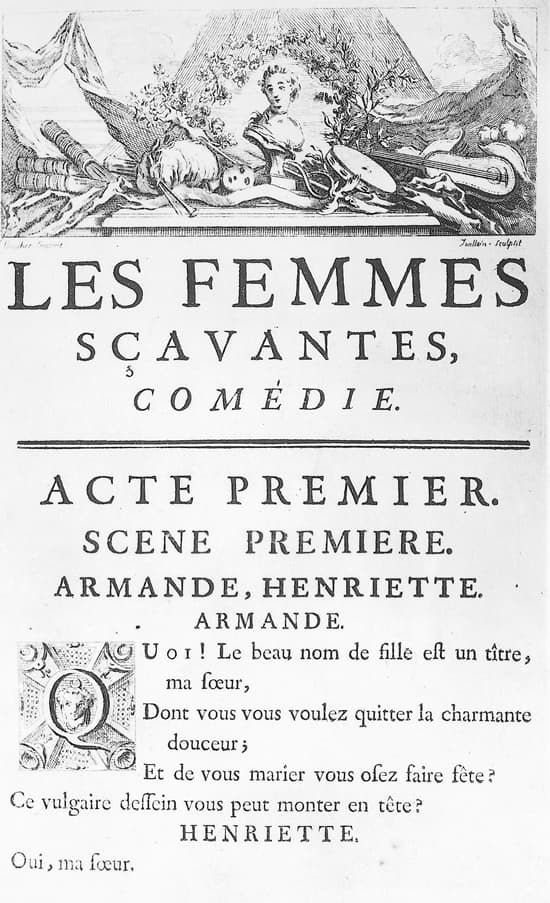
Les Femmes savantes


Les Femmes savantes est une pièce de théâtre, se jouant en cinq actes et écrite en Alexandrins, créée en 1672 au Théâtre du Palais Royal par Molière. 


Okay, ça a l'air réellement barbant, mais c'est parce que vous ne connaissez Molière que de nom! Car il est marrant ce mec du XVIIe siècle. 


Mais pas mon genre d'homme (pas assez de barbe). Trève be plaisanteries. Les Femmes savantes est l'histoire d'une famille divisée, car trois des membres sont subjugués par un pédant. "Pédant" vient du mot italien pedante apparut en Italie au XVIe siècle et devenu populaire en France au XVIIe. Il désigne l'homme faisant étalage de son savoir (qui n'est en fait que parure) afin de pouvoir baratiner les autres. Dans la pièce ici, Trissotin (son nom provenant de l’expression « trois fois sot ») baratine trois femmes de la famille afin de leur soutirer de l’argent. Une de ses trois femmes est courtisée par un jeune homme nommé Clitandre, mais elle est tellement subjuguée par le savoir de Trissotin qu’elle repousse constamment Clitandre qui finit par tomber amoureux de la sœur cadette d’Armande, Henriette.


La scène cinq du premier acte est très drôle, car Clitandre souhaite partager sa joie d’aimer Henriette à la tante de celle-ci, Bélise, mais la tante est tellement imbue d’elle-même qu’elle se croit la cible de son amour. Elle essaie de le repousser et peu importe comment Clitandre essaie de se sortir de ce mauvais pas, elle refuse d’entendre raison. Il finit par lui avouer directement qu’il désire Henriette, mais la tante renchérit comme une vieille perverse et croit qu’il essaie seulement de cacher le désir ardent qu'il a pour elle. Tout est dans le langage. Toute la conversation est subtile, mais c’est ce qui rend le tout hilarant. La tante devient un personnage assez grotesque.


Parlant de grotesque, voilà la mère, qui se bornera à refuser le mariage des tourtereaux parce qu’elle veut marier sa fille Henriette (qui ne s’intéresse pas du tout à l’étude de quoi que ce soit autre que de tenir une maison) à ce charlatan de Trissotin. Henriette voit clair dans le jeu de ce voleur, mais elle souhaite être une bonne fille et, pour ce, elle doit se plier à la volonté de ses parents. Heureusement, son père commence à comprendre qu’il a perdu ses culottes au profit de sa femme il y a de cela fort longtemps. Grâce à l’appui de son frère, il arrivera à faire savoir à sa femme, Philaminte, que certaines de ses décisions lui déplaisent. Philaminte a renvoyé sa servante parce qu’elle « parle mal ». Pour elle, parler mal, c’est, entres autres, ne pas savoir la différence entre « grammaire » et « grand-mère » (à mon sens, ce n'est qu'être ignorant, mais si tu fais ta job, on s'en sacre). Alors que la pauvre cuisinière s’en contre-fiche, Philamente, Bélise et Armande se réclament de la langue de Vaugelas et ne peuvent supporter de telles infamies telles que les proverbes, les pléonasmes, les néologismes, mais surtout elles ne peuvent pas comprendre la mise à l’avant des besoins physiques avant l’étude des savoirs!

Bref, ces trois folles, aujourd’hui, on les appellerait des snobs. Sauf que là, on est au XVIIe siècle et le pauvre père de famille finit par tenir des propos réducteurs pendant qu’il « pète une coche ». Il affirme qu’« Il n’est pas bien honnête qu’une femme étudie et sache tant de choses ». À force d’être occupées à s’enfler la tête d’un intellect de peccadille, les trois femmes ne s’occupent plus de la direction de la maison : à cause de ça, tout le monde pense qu’elles sont en train de perdre la tête et parle dans leur dos. Oh les vilains gens de ces années-là! Ça jugeait sur le ménage ben plus qu’aujourd’hui!

Là, on pourrait croire que Molière critique les femmes qui désirent s’instruire, mais pas du tout! Il est bien noble selon lui de le faire, mais la manière de le faire est aussi importante : pourquoi vont-elles adorer une espèce de prétendu érudit qui les amène à mélanger les doctrines et les savoirs? La culture devrait être une conquête laborieuse et non un faire-valoir superficiel. Bref, la cible du ridicule est leur naïveté et la façon dont Trissotin en abuse.


Sacré Molière! 

Recommandé si...
1. Vous avez un travail à faire sur Molière;
2. Vous avez le goût de lire un classique de la langue française pas trop long et pas trop compliqué;
3. Vous voulez paraître pédant.

Thursday, April 3, 2014

Manhattan Transfer

"Opportunity knocks but once at a young man's door."
What a pessimistic quote, you would say. And you would be right 'cause I just past three horrible weeks reading Manhattan Transfer, a novel by the famous American writer John Dos Passos. I thought I have to write something down to get it set up in my mind, because my student life is so awful right now, I can't even think fully and wholly of one goddamn subject without immediately thinking of something else. And this book doesn't help me to get my mind fixed up! Oh no!


Completely glaucous, the book tries to embody to much things at the same time with an experimental genre where Dos Passos uses a narrative collage technique. My university teacher says it is inspire by cubism. I thought cubism was much more profound then that... In literature, it seems that all perspectives are mixed up, sometimes carefully too much exaggerated and others, not enough as it should be.

The novel, published in 1925, focuses on the life in New York city between an age of prosperity (the Gilded Age) and one of economic decadence after the WWI (the Jazz Age). There's many characters, many plots, a succession of events, and sometimes simultaneously. The problem with that nonlinear narrative is that if you love, as a reader, to associate with one character, it's quite impossible. I just almost succeed to love two of them, which are Ellen and Jimmy. And you will have to read the book to understand why I didn't succeed to be totally fond of them 'cause I don't want to give away to much punches.

When we first met Ellen, she's a little baby. Even if her mother is crazy, her father is a successful businessman who takes care of them. What is truly amazing about her is her ability, as a young woman, to define herself by her art (she's an actress) and not through out the eyes of men.
Jimmy is completely is opposite, I think. Fatherless, his mother dies of a stroke when he is an adolescent. He's raised by his aunt and uncle, but he rebels against the system of financial success in place and turns to journalism to denounce capitalism. He's completely in love with Ellen, but like none of us he can't compete with a "perfect" dead lover.

In the major themes addressed, you have all sense the one of the mean American capitalism. John Dos Passos, in 1925, was a fervent leftist. However, like all (or almost) any human being who becomes successful, he completely changed his rifle edge in his last years. Well, here is some quotes I thought that were really beautiful about his view of the American society at this time:
"But I don't think a flourishing businessman is the highest ideal of human endeavor."
"The more educated a feller is the more use he is to his class." 
"Well perhaps you can tell me why in this country nobody ever does anything. Nobody ever writes any music or starts any revolutions or falls in love. All anybody ever does is to get drunk and tell smutty stories. I think it's disgusting. . . ."


Most of the characters presents in the interminable list of this book have also another goal than financial success, which is to be love and love in return. My favorite part of the book is when Jimmy encounters a guy named Bullock. They are walking outside, both drunk, when Bullock says to Jimmy how badly he wants to die 'cause he can't like women. Jimmy will clear the subject, obviously uncomfortable, by giving him the advice to go to a psychoanalyst. This part touches me by the way it embodies, in 1925 (don't we dare forget it) the horrible situation in which LGBT peoples cannot named themselves and were considered mentally ill. 

So, that was a dreadful everlasting novel, but how inspiring it is, now that I took the time to set it straight up in my mind. I will let you with another quote:
"There are lives to be lived if only you didn't care. Care for what, for what; the opinion of mankind, money, success, hotel lobbies, health, umbrellas, Uneeda biscuits . . . ? It's like a busted mechanical toy the way my mind goes brrr all the time."
Food for thought, uh? What are you caring about that is not as important as you sometimes think it is?

Monday, March 10, 2014

The Polytechnique Massacre in O'Hara Style Mixed with Mal de vivre

(Written the 6th of December, 2013)


Frank O'Hara is Bart Simpsons:

René Magritte
Has a pipe
That is not
A pipe.

Bart is rolling his skate
In front of this pipe
Remembering
The 6th of December, 1989
Where
Fourteen Mona Lisa
Died
Because of this pipe
That is not
A real Pipe. That is
A shadow of a pipe.
Fourteen Mona Lisa zombified
In all minds.

Bart is thinking:
THIS is something
To turn yellow
And 
Stay yellow. 


Monday, March 3, 2014

God Bless America


God Bless America

Where are we so blind to see
That the ones we hurt 
Are you and me?! - Heap
Okay, ça fait pas très universitaire de dire
que le monde est sans dessus-dessous,
qu'on voit pas le bout aux tourments des gens,
à nos propres tourments,
et que CE film
est un expiatoire,
une sorte de sublimation des pulsions de mort
qui nous habite,
qui m'habite.
Certains trouveront ça vulgaire
(Vous voyez à quel point je pense
aux autres
mais surtout
à leur jugement), mais
je vous le dit, ce film me hante.
Jamais je ne tuerai personne,
mais des fois,
j'ai le goût de crier,
crier à défoncer les oreilles
des gens qui m'entourent,
qui devraient m'entourer,
ou des gens qui pourraient avoir
une influence positive
pour moi,
pour vous,
pour tous,
et qui se complaisent dans leur marde.

Bref, je travaille pour une compagnie de merde,
tout comme Frank, the anti-hero,
société qui accuse et qui ne remercie jamais,
à laquelle tu dévoues ta vie,
mais que jamais, jamais,
JAMAIS,
tu peux penser que tu seras rémunéré
comme tu le devrais,
qui te donne bref,
un salaire de crève-faim.

Et là, tu, je, nous,
sommes pris dans une roue,
une roue sans fin
où l'amour, la fraternité, la compassion,
meurt, s'oublie,
et où la haine
à sa place,
petite,
dans un coin,
elle nous dévore,
elle nous tue.

CE film,
bref,
était merveilleux.

Je cherche ailleurs.
Je cherche.
Je cherche.
Mais je trouve pas,
vous non plus.
Ce qui nous va, ce qui nous irait.
Ça n'existe plus.


Comment faire l'amour avec un Nègre sans se fatiguer


Écrit en 1985, ce premier roman de Dany Laferrière décrit la vie de deux Nègres, exilés à Montréal: un met sa foi en le Coran, a Freud pour prophète, et passe son temps à dormir (nommé Bouba, il m'a étrangement fait pensé à un nouveau Bouda primitif-moderne puisqu'il est le Guru d'une jeune Blanche suicidaire); l'autre, un grand amateur de jazz, écrit ce qu'ils vivent ensemble dans le carré Saint-Louis, le manque d'air frais de l'été, la chasse aux Blanches, la baise des Blanches, l'histoire des castes montréalaises.

Certains passages sont en capitales: un cri du coeur? Un vomissement de vérités, ou d'opinions toutes faites plutôt.

Notamment, le narrateur ne cesse de répéter à quel point les blanches ont besoin des nègres pour prendre leur pied au lit, car la blanche est en-dessous du blanc, le nègre dessous la blanche, la négresse dessous le nègre. Donc, le nègre et la blanche au lit réconcilient l'humanité entière. En 1985, j'imagine que ces propos ont été loin de passer inaperçus. Par contre, de nos jours, ils seraient considérés comme un stéréotype comme les autres.
"LA HAINE DANS L'ACTE SEXUEL EST PLUS EFFICACE QUE L'AMOUR."
"LA BLANCHE DOIT FAIRE JOUIR LE BLANC, ET LE NÈGRE, LA BLANCHE."
"L'HISTOIRE NOUS SERT D'APHRODISIAQUE." 
Il explique a quel point les blanches sont naïves: elles ont été enseignées dès leur plus jeune âge à croire ce qu'on leur dit. Alors, un nègre arrive, lui fait son monologue sur sa vie en Afrique, et BANG! dans le lit.
"ET DIRE QU'ON ENVOIE CES FILLES DANS UNE INSTITUTION SÉRIEUSE (McGILL) POUR APPRENDRE LA CLARTÉ, L'ANALYSE ET LE DOUTE SCIENTIFIQUE. ELLES SONT TELLEMENT INFECTÉES PAR LA PROPAGANDE JUDÉO-CHRÉTIENNE QUE DÈS QU'ELLES PARLENT À UN NÈGRE, ELLES SE METTENT À PENSER EN PRIMITIVES. POUR ELLES, UN NÈGRE EST TROP NAÏF POUR MENTIR. C'EST PAS LEUR FAUTE, IL Y A EU, AUPARAVANT, LA BIBLE, ROUSSEAU, LE BLUES, HOLLYWOOD, ETC."
Par contre, il y a tout de même des moments philosophiques poignants où l'auteur pénètre dans l'émotif des  relations humaines, dans la crainte de l'autre, autant que dans sa propre vulnérabilité.
"Dormir, c'est se livrer totalement. C'est le plus que NU."
D'ailleurs, le lecteur peut voir l'évolution de l'écriture du livre du narrateur à travers celui même de l'auteur. Lors d'une entrevue à la fin du roman, le narrateur raconte que les noirs veulent le lyncher pour avoir vendu la mèche dans son roman.
"C'est le destin de tout écrivain que d'être un traître. J'espère que c'est mon premier cliché depuis le début de l'entretien."
Évidement, c'est loin d'être le premier cliché de l'auteur, mais cette phrase est poignante pour tout écrivain en devenir. Un autre cliché, plutôt littéraire, et spécialement bien ficelé se trouve dans le titre du dernier chapitre qui se nomme "On ne naît pas Nègre, on le devient".

***

Ce qui était le plus dramatique dans tout ce scénario à la noix, ce sont les nombreuses références littéraires insérées ça et là comme un retentissement de la "culture" de l'auteur (Pardon Monsieur Laferrière, mais sérieusement... j'étais loin d'y croire). Si on met de côté les nombreuses lectures que le narrateur accomplies (ne faisant que nous citer des noms d'auteurs comme des emblèmes), les quelques allusions littéraires sont plutôt décevantes:
"Drôle de fille, je l'avais rencontré à l'université (à une soirée littéraire typiquement McGill). j'avais laissé entendre que Virginia Woolf valait bien Yeats ou une bêtise de ce genre. Peut-être avait-elle trouvé ça baroque dans la bouche d'un Nègre."
Pour ma part, je crois que comparer Virginia Woolf et Yeats devrait être un crime.
"Miz Littérature a une famille importante, un avenir, de la vertu, une solide culture, une connaissance exacte de la poésie élisabéthaine et même, elle est membre d'un club littéraire féministe à McGill - les Sorcières de McGill - dont les membres s'occupent de remettre en circulation les poétesses injustement oubliées. Cette année, elles publient en édition de luxe, avec des encres de Valérie Miller, l'oeuvre poétique d'Emily Dickinson."
Entres toutes les poétesses, l'auteur a choisi Emily Dickinson. Elle est enseigné dans les Cégeps et les Universités dans tous bons cours d'anglais. Et on parle ici d'une jeune étudiante de McGill. Bon, on parle d'un livre écrit en 1985, mais ça ne fait tout de même pas cinquante ans. J'adore Dickinson, mais elle est loin d'avoir été "injustement oubliée".

***

Recommandé si vous aimez les courts chapitres, si vous avez une aversion pour les charmeurs (et que vous aimez comme moi être challenger dans vos valeurs), ou si vous êtes dans un cours de littérature québécoise au Cégep (facile à lire et divertissant). 

Thursday, February 6, 2014

Yonnondio: From the Thirties

"And now your father lies beside her, stroking and kissing her hair, silently making old vows again, vows that life will never let him keep."


Tillie Olsen has never finished to write this book about a proletarian family stifling and starving in the 1930s, during the Great Depression. The quote above is about one major theme of the novel: the role of the father. Jim rapes his wife, Anna, which will miscarry after that and will become sick. All this moment is narrated from the point of view of Mazie, there eldest child. She will find her mother lying on the floor, full of blood.
"Dont, Jim, dont. It hurts too much. No, Jim, no."
 "Cant screw my own wife. Expect me to go to a whore? Hold still."
The merciful blood pounding in Mazie's ears, battering away the sounds.
When Anna comes back to life, Jim promises her a better life. He always does so throughout the novel. Poor guys are good at it. Critics say it proves that Jim could have been a better man if life would have let him the chance. I don't think so. Jim is an asshole. I mean... If you're raped by your own husband that can't be a "good" man. Whatever the situation was: he just has to keep his snake in his pants.

Right at the beginning of the novel, Mazie recognizes the sound of death: the whistle from the mine. Violence in this novel often occur in the form of unsafe working conditions. And what was struggling the most is that, some people are still living in these conditions today. How embarrassing it is that a novel written in the 1970s about life in the 30s is still talking about present-day issues?

On another panel, the mother and Mazie are so near from one another that the reader will passed from one point of view to the other in a stream of consciousness where their lives are completely determined by the decisions of Jim. In this true patriarchal world, Anna will quietly slip from the real world into another, where Mazie will be driven. Physical, emotional and psychological sufferings are integral parts of the novel and never really get away from the family.

Seriously, this book pissed me off. Sometimes, I cried of rage against impossible situations. Even my ideological belief in education was washed away. The family will travel from the mines to a farm, and from the farm to a dump house in the country. And, even if their story have no real ending, reading it will make you carry Mazie and Anna's sorrows in your heart.