Wednesday, May 14, 2014

Bomb Girls

Set in the 1940s, Bomb Girls' show on Global was based on the women who "risked their lives" in a munitions factory in Canada (!!) building bombs for the Allied forces fighting the European front. (I put it in inverted commas because there were also men at the front risking their life too, and that's two different kind of "risks".) As the world around themselves changes profoundly, these girls also find themselves changing, wanting more of life than any girls before. They find themselves free, liberated, in a world in war, where social restrictions are lowered, but death and sorrow are also never far. Global has tested this show: will it have the same success as other American shows? The answer is inconclusive: new shows entered the game and Bomb Girls closed... However, before to leave all its fans, the production made a movie! Yeah!

When I first came across this show, it was my boyfriend who told me we absolutely have to watch it together. Hasn't he great taste?! Well... I've truly fell in love with this show, and all the girls, Lorna, Marco, and Ivan. Let me tell you why: they are lovely.
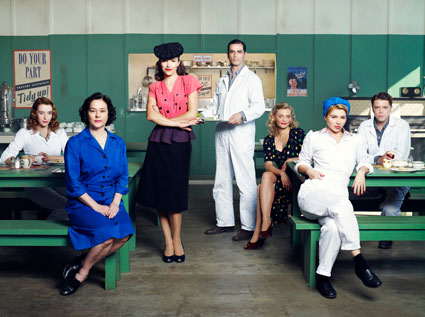

The girl completely at the left is called Kate Andrews. She is the daughter of a street-preacher who is completely scaring and, who beats her. One day, helped by her mother, she ran away and hide under another name. She is hired in the munitions factory, and became best-friend with Betty (the woman in white at the front of the picture). At one moment, she is engaged to Betty's ex-boyfriend, Ivan (the boy at the right of Betty in the picture). By the way, she is also a great singer. Through out the show her passion for singing is represented as a gift from God that can change lives.

Lorna Corbett (the woman in blue) is the floor matron of Victory Munitions. Her two sons are at the war, her daughter is a nurse's aide, and her husband was mutilated in the Vietnam war. She is a very sensible person, and has strong moral and traditional values. However, like everybody, she has weaknesses. She is like a mother for the girls working at the factory.

The chic girl at the center is called Gladys Witham. She is born in a rich family of Toronto. She is originally supposed to work in the office of the factory, but 'miss' wants to change the world, so she starts to work on the floor with the other girls even if they are making fun of her. Betty, for example, will never stop calling her "princess": at first as an insult, and later on as a friendly nickname. Although Gladys has a strong personality and that I easily accepted the transition from rich girl to bomb-maker, I wasn't fond of her turned over in a spy. I did not quite believe in it... The movie deceives me, because it was based on her mission as a spy. She is also depicted as having libertine values, which are also not really believable. I think I am severe about this character because I had strongly relate to her at the beginning of the show; now that she has become a spy, she is the number one liar in the world while I can't even say a lie without reddening! Whatever!

Marco Moretti (the man who resembles to a Greek) is an expatriate man from Italy. He is living with his mother. His father has been sent away to an internment camp. He is often incriminate due to his heritage. Gladys will often help him (using her connections) to put him out of some bad luck. However, at a certain point, Marco becomes a real bad-ass, but he's having an affair, a truly lovely affair, with Vera, and she puts him back to his place, i.e. a munitions factory worker of Canada. Their love is so so so so cuuute. I just fell in love with the two of them. 

Vera Burr (the cute blond girl at his left side) is disfigured in an accident at the factory. At a certain point, she wants to give up with life... Her story is so inspiring that I cannot believe what had happened in the movie (yes the film follows the series). Brief, I don't want to give away more information about her: just say that she is a veteran even if she doesn't have the badges.

The last girl completely at the right of the picture is the most sexy butch I've never seen on TV: Betty McRae. She's the best worker at the factory, and she is in charge of training the new girls. She always takes everything so deeply personal that her friends often have to stop her from becoming a boxing player (which is quite ironic as she would become one in the movie). Well, even if her lesbianism is hidden, let me tell you that the most erotic lesbian scene of all TV can be found in the second series (between her and Teresa, not Kate, sorry). 

Last, but not the least, Ivan Buchinsky is an engineer at Victory Munitions who works during the Blue Shifts (as all the other characters named here). He will first fall in love with Betty who is trying to be "normal," but who will finally put an end to this relation going nowhere. He will turn to Kate... and ask her to marry him! Sincerely, this character is a sad one. It seems like the director was trying to tell us: "this is what you will get if you are to sweet, to gullible". Poor guy seriously. Always with some sort of double-life-girls who will lie to him and abuse him. However, he is the incarnation of the perfect man: sweet, cute, dedicated to love... (He is not bad ass, but I'll tell you what, girls: never let go a guy like this. He will do anything to make you smile. Forget the bums: they are a waste of time and energy.)

Well, this show was amazing. I'm sad it is finished. However, you can see all episodes on Global for free. To know more, check on the National Post's article on Bomb Girls' series and the website created to save them.


Have you seen the series or the movie? Did you like it? Why? Don't be shy: let me a comment!

Saturday, May 10, 2014

Departures: Memoirs. By Paul Zweig.

"I've never been much good at transitions. Over the years, I have gone as if expelled, dragged or broken from one life to another, never quite willing or knowing. It has been all zigzags, changes that sprang from nowhere and became irreversible, as if I had been shunted onto another plane of life, never choosing and never prepared."
Paul Zweig is a Jew born in America, a little after WWII. Already as a child, he doesn't consider himself as a 'real American' neither as a 'real Jew.' All his life will be spent in this quest of his self, and for that matter, he will voyage through the earth to find out who he really is.

 Paul Zweig. Dead in 1984.

Departures: Memoirs is in part a rewriting of one of his earlier novel named Three Journeys, and a memoir of his life spent in departures. Against all odds, Zweig is writing on his death's bed for is relatives, especially for his daughter, but as readers, we could have think that he would have been more modest in his writing; instead, the readers can sense the fertility, the sexuality of Paris has never we can sense it now. An enormous part of his memoirs is about sex, his penis and his loneliness. 
"But an anxious solitude possessed me. I felt numb, alone with my lanky thighs, my belly that was already a little domed, my chest hairs and my clotted curls of public hair; alone with my penis that had retracted and become insignificant, like one of those marginal outcast boys with fat unhealthy faces in my classes in elementary school."
What is really interesting about Zweig is his ability to throw all his self in his quest of the French language:
"I decided that I was going to read all of French literature, starting at the beginning."
And the reader can feel his difficulties, that he finishes to overcome language, and masters it: winning the battle, becoming the other. His memoirs are truly the immersion of an expatriate man, in the mid-1950s to the mid-1960s, who senses he never has a homeland.

The second interesting fact about this book is Zweig's implication in the Algerian war. I will not say much about that, because I would like you to read all his nostalgia about life and death, about the known and the unknown, love and hate, peace and war. The last chapter made me wept... This is just to say that this book's worth reading.


Recommended if you love memoirs and if you are interested to know more about France in the mid-1950s.


Wednesday, May 7, 2014

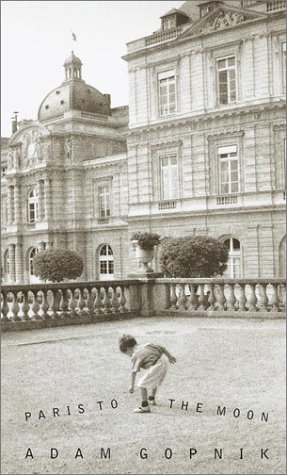
Paris to the Moon

Hi you all, darlings of my life!

I've just finish my school semester and this is a total relief. The two last books I've just read were amazing. So, I'll start with one of them and you'll know the other on Sunday. I want to post more regularly now: let's say at each three or four days.


"The differences are tiny and real. Cultures don't really encode things. They include things, and leave things out."
Adam Gopnik has a highly reputation as a journalist of the New Yorker. In 1995, his first child was born in New York, and his wife and him decided that they want to live in Paris in order that their child can have a beautiful existence. The premise is strange. What weird parents would do a thing like that to their child: expatriate him from his family and friends before he can even know them! But whatever, I enjoyed the book. From Paris, during five years, Gopnik will write a column in the New Yorker about topics of his life in France. Paris to the Moon is a compilations of those reports, with four more never handed, and a first chapter (titled as the book) that has been written after.

Gopnik.

It sure is a first narrator who completely knows where he comes from, what he is doing, why he is doing it, and where he will go. What is strange about this book is that even if the narrator is a complete American with his capitalist view of the world and his touristic ways to do things outside his country, he is so full of love for his child, for his wife, for life in itself that it is really difficult to not like his writing. In fact... he is so cheesy. Two examples:

The first is when one of his friend (back in New York, on one of Gopnik visits for Christmas times) asks him why they lives in Paris, Gopnik writes:
"So, Paris. 'We want him [his child] to grow up someplace where everything he sees is beautiful,' we said, and though we realized that the moment our backs were turned our friends' eyes were rolling, we didn't care. We knew that our attempt to insist on a particular set of pleasures for our kid−to impose on our child−might be silly or inappropriate or even doomed. We couldn't help it, entirely. The romance of your child's childhood may be the last romance you can give up."
Isn't it cheesy? Is it gonna work? I mean, is his kid gonna like his life in Paris? Will he take Paris as his home? Or New York? Grown-up, will he find it as romanced as his father had?

The second is that through out his writing he tries to put words on how his country is seen in France and why, but even if he do sees the truth behind some assertions, he just can't bear it. So, to sublime it maybe, he'll gonna transform it in fictions such as comparing Americanism with a T. rex.

Okay, maybe I'm psychoanalyzing Gopnik a little too much, but one thing is sure: this book is refreshing, funny, silly sometimes, but oh-how-really-humane. Even if his aristocratic life deludes him on some aspects of Paris, he nevertheless expresses the will of human being to overcome differences and to enjoy life together.

Paris to the Moon's graphical view given in the book.

I like the way his wife presents their return in New York, concluding the book on a kind of reflexion about what exactly home should be:
"We have a beautiful existence in Paris, but not a full life," Martha said, summing it up, "and in New York, we have a beautiful life and an unbeautiful existence."
Weirdly, I think they're right. You can have only two choices in life: one is to stay right where you are and feel the love and the needs of the ones whom are important for you, the other is to fly where wind brings you, discover and keep on learning about the beauty of diversity. The first one is the easy choice; the second is the difficult controversial one, but that's the one where romance takes place. What do you think?

Just another silly, but so cute moment in his child's childhood in Paris.

Recommended if you want to see Paris through the eyes of an American, if you have a great sense of humor, and if you want to truly know some differences between two cultures that have been at the top of the international economy.

Don't be shy: write a comment! I need to know how you like this post and this blog. Have you read this book? If yes, what were your feelings about it? If not, would you like to?


Wednesday, April 23, 2014

Cromwell

"Tu souris, Thurloë. Tu ne sais pas quel vide
Creuse au fond de nos coeurs l'ambition avide !
Comme elle fait braver douleur, travail, péril,
Tout enfin, pour un but qui semble puéril!" 

Sincèrement, je n’avais pas réellement envie d’écrire sur ce chef d’œuvre de la langue française, mais après cinq cents pages, avais-je le choix? De toute façon, je vous devais bien d'écrire sur quelques classiques pendant les examens finaux!

Donc, le grand Victor Hugo décide au XIXe siècle d'écrire une pièce historique coupant abruptement avec les idéaux du classicisme et ouvrant la porte à ceux du romantisme. Pour Hugo, quelle règle absurde que celle des trois unités! Il revendique un théâtre axé sur le divertissement du public certes, mais surtout sur son éducation. Alors, tout bonnement, il decide d’écrire une pièce en mémoire de la clôture de l’absolutisme en Angleterre. Écrire à propos du Protecteur Olivier Cromwell, régicide (meurtrier du Roi), ayant atteint la tête du parlement. Il faut du culot! De plus, les personnages abondent dans cette pièce (atteignant presque soixante-dix!) et les changements de décors luxueux en fond une pièce irréalisable. Elle n’a en fait été jouée qu’une seule fois, en version abrégée d’ailleurs, en 1956.

Portrait d'Olivier Cromwell par Samuel Cooper


Donc, pour décrire la pièce en tant que telle, c’est une fresque de l’Angleterre du XVIIe siècle mettant en scène le complot réunissant les républicains et les royalistes contre Cromwell, Lord Protecteur d’Angleterre (pour une fois qu’ils s’allient, c’est ironiquement pour commettre un meurtre). Les royalistes lui en veulent pour l’exécution de Charles Premier, alors que les républicains sont outrés à l’idée que Cromwell puisse convoiter la couronne d’Angleterre. Cromwell ne se doute aucunement qu’il est menacé de mort s’il accepte la couronne malgré les nombreux indices sur sa route qui démontrent la face cachée de ces bons chrétiens.

Sincèrement, tous les personnages de cette pièce sont représentés comme des idiots orgueilleux. Ils seront tous dupés par leur propre orgueil, sauf Cromwell (malheureusement). Cependant, la seule personne réellement saine d’esprit, et pleine d’esprit par le fait même, est Francis, la fille de Cromwell. Elle est présentée comme un rafraichissement au lecteur alors même qu’elle oblige un pauvre idiot qui la courtisait (tout en se faisant passer pour un homme de Dieu!) à épouser son affreuse gérante. Le moment est si ironique que j’en ai ri tout haut.

La pièce fait le quatre cinquième de l’œuvre et, pourtant, c’est son préface qui a marqué l’histoire littéraire. Il est représenté comme une « image cartographique du voyage poétique » que l’auteur venait d’achever. Donc, la préface (qui est plutôt une postface) est un manifeste des idées conçues pendant la conception de l’œuvre. Ce véritable manifeste culturel et littéraire du romantisme est « assez, très, beaucoup » poétique. Pour vous faire un topo sans passer par quatre chemins comme l’auteur, il prescrit de s’inspirer de l’histoire (culturelle et littéraire) sans pour autant laisser le génie créateur s’entraver de contraintes. Donc, adieu les règles du classicisme! Bienvenue à l’idée de l’évolution! Non seulement d’un point de vue sociétaire, mais aussi langagier. En fait, Victor Hugo préconise le mélange des genres afin de se faire croiser le « sublime » et le « grotesque » à des fins représentatives du réel. Et seul peut le faire, le genre du drame. Et seul peut le faire l'organisme vivant qu'est la langue française!

Le drame, pour Cromwell, c’est d’avoir tué le roi pour lui prendre sa couronne, mais ne pas l’obtenir et seulement en rêver. Qui n’a pas d’aussi beaux rêves sans jamais les réaliser? Qui risque la mort pour vouloir les atteindre?

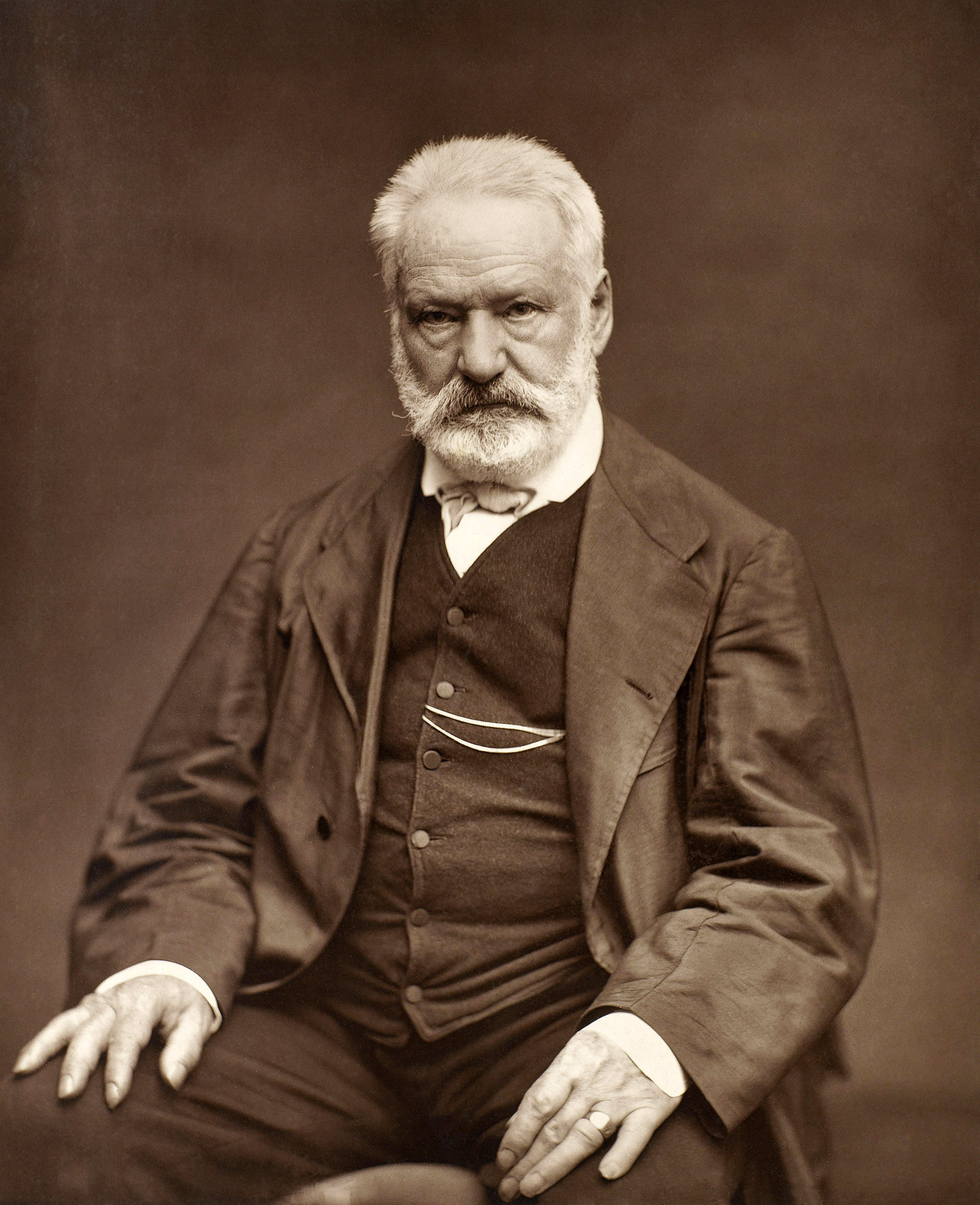
Victor Hugo, vieux et beau.


Recommandé…
Si vous avez un travail de Cégep ou d’université à faire, beaucoup de temps devant vous, et que l’histoire d’Angleterre vous intéresse;
Si vous voulez vous instruire;

Si vous n’êtes pas trop rebutés par les Alexandrins.  

Thursday, April 17, 2014

Loon Lake

"They'll work at a job and not know why. They'll marry a woman and not know why. They'll go to their graves and not know why. . . . I've never understood it, but there it is. I've never understood how a man could give up his life, give it up, moment by moment, even as he lives it, give it up from the second he's born. But there it is. Bow his head. Agree. Go along. Do what everyone's doing. Let it leach away. Sign it away. Drink it away. Sleep it away."

I have so much things to say about this novel... This is insane.

First, I'll introduce you to its author, because he's worth it (the proof is that his work has been published in thirty languages!). Born in 1931, he's not dead yet, and he's been a prolific writer on a unique work: historical fiction. E.L. Doctorow thinks that America lacks of historical substance that normally gives opportunity in literature to work on as a writer (in its interpretation, reinterpretation, and invention). Among others, Doctorow wrote Ragtime, The Book of Daniel, Lives of the Poets, and Welcome to Hard Times. Doctorow was at first an editor, but he left publishing in order to write.


Loon Lake was written in 1980, but situates its narrative around the Great Depression. The postmodernist novel intermixes three different genres (bildungsroman, picaresque, and proletarian) in addition to mix up poems in a nonlinear narrative switching from the first to the third point of view and between two characters. Poems are mostly notes on Warren's life, and people he encounters. What is more destabilizing is the technique of stream of consciousness that is everywhere.

"I had the uncanny feeling that he was translating what I told him into another language."

When I started reading Loon Lake, I was overwhelmed by all these layers. I checked out the reviews, and was stunned by all the bad critics. However, I keep going (I had to read it for an university class), and I forgot to sleep one night, too caught up in the story. Joe is a hobo born in a poor family, as most of the characters are (Warren, Clara, Sandy, Libby). He quits his parents to live where life brings him. At a certain point, he is attacked by savage dogs on a propriety of a millionaire where he will encounter whom he seems to think is the love of his life, Clara. However, he has to take her out of this estate, because she is the propriety of Tommy Crapo, an awful and prosperous gangster (who will return there soon), and Warren (who lives there too) is also completely in love with her.

"But how she felt was overriding importance to me, how she felt!—then and every moment after—was my foremost concern, what I lived by."

The self-conscious narrative about one or the other narrator brings me up to be skeptic about their reliability, mainly about Joe. Is he telling the whole truth or is he making it all up like he is doing with the cops?

"You are thinking this is a dream. It is no dream. It is the account in helpless linear translation of the unending love of our simultaneous but disynchrous lives."

The end is so unexpected that I cannot even put words on it. All that the reader can have expected is swept aside.

The way the novel mixes high and low art, fiction and non-fiction, literary genres, dissolving love and hate, aggressiveness and sweetness, amorality and morality (...) makes me fall in love with it, but also with E.L. Doctorow. This author is a genius! Finally, all the narrative is based on one excellent question of life: which is more important than the other: freedom or material wealth? At the beginning, Joe thinks they are incompatible. Will you be willing to hear his conclusion?

I recommend you Loon Lake if you are willing to live an extraordinary adventure of experiences with literature, if you like to be surprise, and if you want to transcend the need of a linear narrative.

Wednesday, April 9, 2014

Les Femmes savantes


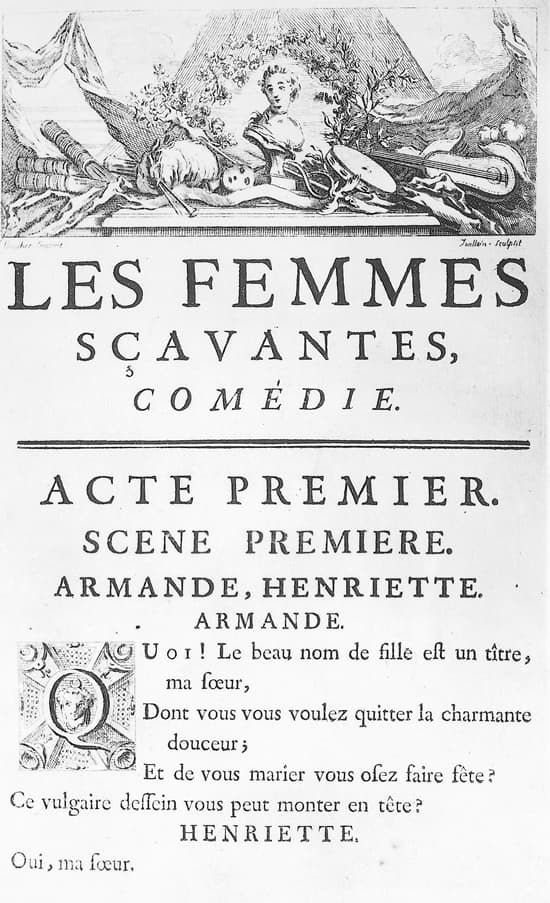
Les Femmes savantes est une pièce de théâtre, se jouant en cinq actes et écrite en Alexandrins, créée en 1672 au Théâtre du Palais Royal par Molière. 


Okay, ça a l'air réellement barbant, mais c'est parce que vous ne connaissez Molière que de nom! Car il est marrant ce mec du XVIIe siècle. 


Mais pas mon genre d'homme (pas assez de barbe). Trève be plaisanteries. Les Femmes savantes est l'histoire d'une famille divisée, car trois des membres sont subjugués par un pédant. "Pédant" vient du mot italien pedante apparut en Italie au XVIe siècle et devenu populaire en France au XVIIe. Il désigne l'homme faisant étalage de son savoir (qui n'est en fait que parure) afin de pouvoir baratiner les autres. Dans la pièce ici, Trissotin (son nom provenant de l’expression « trois fois sot ») baratine trois femmes de la famille afin de leur soutirer de l’argent. Une de ses trois femmes est courtisée par un jeune homme nommé Clitandre, mais elle est tellement subjuguée par le savoir de Trissotin qu’elle repousse constamment Clitandre qui finit par tomber amoureux de la sœur cadette d’Armande, Henriette.


La scène cinq du premier acte est très drôle, car Clitandre souhaite partager sa joie d’aimer Henriette à la tante de celle-ci, Bélise, mais la tante est tellement imbue d’elle-même qu’elle se croit la cible de son amour. Elle essaie de le repousser et peu importe comment Clitandre essaie de se sortir de ce mauvais pas, elle refuse d’entendre raison. Il finit par lui avouer directement qu’il désire Henriette, mais la tante renchérit comme une vieille perverse et croit qu’il essaie seulement de cacher le désir ardent qu'il a pour elle. Tout est dans le langage. Toute la conversation est subtile, mais c’est ce qui rend le tout hilarant. La tante devient un personnage assez grotesque.


Parlant de grotesque, voilà la mère, qui se bornera à refuser le mariage des tourtereaux parce qu’elle veut marier sa fille Henriette (qui ne s’intéresse pas du tout à l’étude de quoi que ce soit autre que de tenir une maison) à ce charlatan de Trissotin. Henriette voit clair dans le jeu de ce voleur, mais elle souhaite être une bonne fille et, pour ce, elle doit se plier à la volonté de ses parents. Heureusement, son père commence à comprendre qu’il a perdu ses culottes au profit de sa femme il y a de cela fort longtemps. Grâce à l’appui de son frère, il arrivera à faire savoir à sa femme, Philaminte, que certaines de ses décisions lui déplaisent. Philaminte a renvoyé sa servante parce qu’elle « parle mal ». Pour elle, parler mal, c’est, entres autres, ne pas savoir la différence entre « grammaire » et « grand-mère » (à mon sens, ce n'est qu'être ignorant, mais si tu fais ta job, on s'en sacre). Alors que la pauvre cuisinière s’en contre-fiche, Philamente, Bélise et Armande se réclament de la langue de Vaugelas et ne peuvent supporter de telles infamies telles que les proverbes, les pléonasmes, les néologismes, mais surtout elles ne peuvent pas comprendre la mise à l’avant des besoins physiques avant l’étude des savoirs!

Bref, ces trois folles, aujourd’hui, on les appellerait des snobs. Sauf que là, on est au XVIIe siècle et le pauvre père de famille finit par tenir des propos réducteurs pendant qu’il « pète une coche ». Il affirme qu’« Il n’est pas bien honnête qu’une femme étudie et sache tant de choses ». À force d’être occupées à s’enfler la tête d’un intellect de peccadille, les trois femmes ne s’occupent plus de la direction de la maison : à cause de ça, tout le monde pense qu’elles sont en train de perdre la tête et parle dans leur dos. Oh les vilains gens de ces années-là! Ça jugeait sur le ménage ben plus qu’aujourd’hui!

Là, on pourrait croire que Molière critique les femmes qui désirent s’instruire, mais pas du tout! Il est bien noble selon lui de le faire, mais la manière de le faire est aussi importante : pourquoi vont-elles adorer une espèce de prétendu érudit qui les amène à mélanger les doctrines et les savoirs? La culture devrait être une conquête laborieuse et non un faire-valoir superficiel. Bref, la cible du ridicule est leur naïveté et la façon dont Trissotin en abuse.


Sacré Molière! 

Recommandé si...
1. Vous avez un travail à faire sur Molière;
2. Vous avez le goût de lire un classique de la langue française pas trop long et pas trop compliqué;
3. Vous voulez paraître pédant.

Thursday, April 3, 2014

Manhattan Transfer

"Opportunity knocks but once at a young man's door."
What a pessimistic quote, you would say. And you would be right 'cause I just past three horrible weeks reading Manhattan Transfer, a novel by the famous American writer John Dos Passos. I thought I have to write something down to get it set up in my mind, because my student life is so awful right now, I can't even think fully and wholly of one goddamn subject without immediately thinking of something else. And this book doesn't help me to get my mind fixed up! Oh no!


Completely glaucous, the book tries to embody to much things at the same time with an experimental genre where Dos Passos uses a narrative collage technique. My university teacher says it is inspire by cubism. I thought cubism was much more profound then that... In literature, it seems that all perspectives are mixed up, sometimes carefully too much exaggerated and others, not enough as it should be.

The novel, published in 1925, focuses on the life in New York city between an age of prosperity (the Gilded Age) and one of economic decadence after the WWI (the Jazz Age). There's many characters, many plots, a succession of events, and sometimes simultaneously. The problem with that nonlinear narrative is that if you love, as a reader, to associate with one character, it's quite impossible. I just almost succeed to love two of them, which are Ellen and Jimmy. And you will have to read the book to understand why I didn't succeed to be totally fond of them 'cause I don't want to give away to much punches.

When we first met Ellen, she's a little baby. Even if her mother is crazy, her father is a successful businessman who takes care of them. What is truly amazing about her is her ability, as a young woman, to define herself by her art (she's an actress) and not through out the eyes of men.
Jimmy is completely is opposite, I think. Fatherless, his mother dies of a stroke when he is an adolescent. He's raised by his aunt and uncle, but he rebels against the system of financial success in place and turns to journalism to denounce capitalism. He's completely in love with Ellen, but like none of us he can't compete with a "perfect" dead lover.

In the major themes addressed, you have all sense the one of the mean American capitalism. John Dos Passos, in 1925, was a fervent leftist. However, like all (or almost) any human being who becomes successful, he completely changed his rifle edge in his last years. Well, here is some quotes I thought that were really beautiful about his view of the American society at this time:
"But I don't think a flourishing businessman is the highest ideal of human endeavor."
"The more educated a feller is the more use he is to his class." 
"Well perhaps you can tell me why in this country nobody ever does anything. Nobody ever writes any music or starts any revolutions or falls in love. All anybody ever does is to get drunk and tell smutty stories. I think it's disgusting. . . ."


Most of the characters presents in the interminable list of this book have also another goal than financial success, which is to be love and love in return. My favorite part of the book is when Jimmy encounters a guy named Bullock. They are walking outside, both drunk, when Bullock says to Jimmy how badly he wants to die 'cause he can't like women. Jimmy will clear the subject, obviously uncomfortable, by giving him the advice to go to a psychoanalyst. This part touches me by the way it embodies, in 1925 (don't we dare forget it) the horrible situation in which LGBT peoples cannot named themselves and were considered mentally ill. 

So, that was a dreadful everlasting novel, but how inspiring it is, now that I took the time to set it straight up in my mind. I will let you with another quote:
"There are lives to be lived if only you didn't care. Care for what, for what; the opinion of mankind, money, success, hotel lobbies, health, umbrellas, Uneeda biscuits . . . ? It's like a busted mechanical toy the way my mind goes brrr all the time."
Food for thought, uh? What are you caring about that is not as important as you sometimes think it is?