Thursday, May 22, 2014

« Paradis, clef en main » de Nelly Arcan

« ON A TOUS DÉJÀ PENSÉ SE TUER. »
C'est la première phrase de Paradis, clef en main, le dernier roman d'Isabelle Fortier sous son nom-de-plume Nelly Arcan. Très connue dans la littérature canadienne, cette auteure réussit toujours à venir m'arracher les entrailles. Quand je la lis, j'ai envie de crier, de me débattre et de pleurer. Ces romans sont toujours un cri du coeur face à cette vie dont personne ne détient le secret du bonheur.


Dans Paradis, clef en main, Arcan est fidèle à elle-même en abordant le thème de la haine de soi, mais cette fois-ci en soulevant le débat du suicide. Antoinette Beauchamps, la narratrice, est une jeune fille suicidaire. La mort pour elle serait une délivrance de la vie, car la vie n’est que douleur. Elle vit isolée de tous, sauf de sa mère, et de son oncle Léon. Sa vie n’est dirigée que par le but de se donner la mort. Elle insiste sur le point que ce n’est pas qu’une envie. C’est une sorte de maladie, ou plutôt un manque à la naissance : celui du désir de vivre. Selon elle, il serait peut-être héréditaire puisque son grand-père s’est suicidé et que Léon se suicidera aussi quelques années plus tard. En fait, à travers la mort de son oncle, Antoinette découvrira comment procéder à son propre suicide.

Ce qui m’a le plus mystifié dans ce roman est la création de la compagnie Paradis, clef en main par « Monsieur Paradis », un ancien médecin qui sauvait des milliers de gens de la mort, bouleversé par le suicide de son fils unique.

« Il a sauvé beaucoup de gens de la mort. Maintenant, il sauve des gens de la vie. »

Afin d’avoir droit à son suicide sur mesure, Antoinette doit en payer le prix monétaire, mais aussi prouver par une série d’épreuves que son désir de mourir est incurable. Le lecteur sait d’avance que le suicide n’a pas fonctionné et a causé la paraplégie de la narratrice. De son lit, elle nous raconte depuis son enfance ce qui l’a emmené à ce suicide raté à la Marie-Antoinette, ce qu’elle se rappelle, et comment cette histoire a fini par changer sa vie d’une manière que le lecteur ne peut prévoir.

Ce fut une expérience si étrange de lire ce roman en sachant qu’il a été publié à la suite du suicide de l’auteur (deux mois après). Loin d’être un livre pro-suicide ou l’explication du suicide de l’auteure, la narratrice entre les lignes racontent plutôt comment l’écriture de ce roman, comment le processus de création, crée une sublimation inestimable.

J’ai une amie qui n’aime pas du tout Nelly Arcan. Elle dit qu’elle est « trop dans sa tête » et « qu’il ne se passe pas grand chose ». Ses romans sont psychologiques, émotifs, à la ressemblance de ce moment où votre vie défile devant vos yeux juste avant de mourir. Plein de choses se sont passées, mais toutes ses choses sont toujours mis en face d’un avenir complètement différent.

Cette femme est juste tellement belle. 
Elle a des airs de famille pour moi, celle de la famille de ma mère.

Visitez son site web. Dites-moi si vous aimez cette auteure canadienne, mais surtout québécoise!


Thursday, May 15, 2014

Bomb Girls en français: Des femmes et des bombes


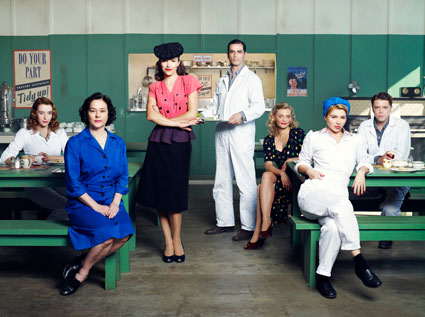
La première fois que je suis tombé sur ce show télé, c'était mon petit ami qui m'a dit que nous devions absolument le regarder. Maudit qu'il a du goût, mon amoureux! Et comme vous le devinez... Je suis vraiment tombée en amour avec ce spectacle, et toutes ces filles, et Lorna, et Marco, et Ivan. Permettez-moi de vous dire pourquoi: ils sont tous profondément beaux à l'extérieur comme à l'intérieur. Situé dans les années 1940, Bomb Girls a d'abord été joué sur Global et était basé sur les femmes qui «ont risqué leur vie» dans une usine de munitions au Canada (!) en réalisant la construction de bombes pour les forces alliées combattant le front européen. (J'ai mis des guillemets parce qu'il y avait aussi des hommes à l'avant qui risquent leur vie aussi, et disons que c'est deux types différents de «risques»...) Pendant que le monde autour d'eux change profondément de mentalités et de traditions, ces jeunes filles se retrouvent également changer à vouloir plus de la vie que toutes les filles ayant vécu avant elle: et elles en ont la possibilité! Elles se retrouvent libres, libérées, dans un monde en guerre, où les restrictions sociales sont réduites, mais où la mort et la douleur sont également jamais loin. Global a testé ce spectacle: pourrait-il avoir le même succès que les autres émissions américaines? La réponse n'est pas concluante: de nouveaux spectacles sont entrés dans le jeu et Bomb Girls a du fermé ces portes... Cependant, avant de laisser tous ses fans, la production a fait un film, à mon grand bonheur! Laissez-moi vous présenter mes amours perdus:

La jeune fille complètement à gauche de l'image qui suit est appelée Kate Andrews. Elle est la fille d'un pasteur de rue qui est effrayant et qui la bat... Un jour, aidé par sa mère, elle s'enfuit et se cache sous un autre nom. Elle est ensuite engagée dans une usine de munitions, et devient la meilleure amie de Betty (la femme en blanc à l'avant de la photo). À un moment, Kate se fiance à l'ex-petit ami de Betty, Ivan (le garçon à la droite de Betty dans l'image). Par ailleurs, elle est aussi une grande chanteuse. À travers les épisodes, sa passion pour le chant est représentée comme un don de Dieu qui peut changer la vie.


Lorna Corbett (la femme en bleu) est la gérante de plancher de la compagnie Victory Munitions. Ses deux fils sont à la guerre, sa fille est aide-infirmière, et son mari a été mutilé pendant la guerre du Vietnam. Lorna est une personne sensible, avec de fortes valeurs morales et traditionnelles. Cependant, comme tout le monde, elle a ses faiblesses que l'on découvre avec elle tout au long des séries. Elle est comme une mère pour les filles qui travaillent à l'usine. La grandeur de son coeur ne semble pas avoir de limites.

La chic fille au centre de l'image est appelée Gladys Witham . Elle est née dans une riche famille de Toronto. Elle est à l'origine censée travailler dans le bureau de l'usine, mais «miss» veut changer le monde, alors elle s'arrange pour travailler sur le plancher avec les autres filles, même si celles-ci se moquent d'elle. Betty, par exemple, ne cessera jamais de la surnommer «princesse»: d'abord comme insulte, et plus tard comme un surnom amical. Bien que Gladys a une forte personnalité et que j'ai facilement accepté la transition entre sa position de fille riche à faiseuse de bombes, je n'ai pas encore accepté son état suivant d'espionne. Je n'y ai pas vraiment cru en fait... Le film m'a déçu un peu parce qu'il était basé sur la mission de Gladys en tant qu'espionne. Elle est également décrite comme ayant des valeurs libertines, qui ne sont pas vraiment crédible. Je pense que je suis sévère sur ce personnage parce que je m'étais fortement associée à elle au début de l'émission alors que lorsqu'elle est devenue une espionne, ça ne collait plus du tout avec moi. Elle est devenue une bonne menteuse alors que je ne peux même pas dire un mensonge sans rougir! 

Marco Moretti (l'homme qui ressemble à un Grec) est un expatrié d'Italie. Il vit avec sa mère. Son père a été renvoyé à un camp d'internement. Il est souvent incriminé en raison de son patrimoine. Pourtant, il aime le Canada comme son propre pays, ou plus. Gladys va souvent l'aider en utilisant ses connexions de gens hauts-placés pour le sortir de ses malchances. Cependant, à un certain point, Marco devient un vrai bad-ass, mais il a une liaison, une affaire pleine de charme, avec Vera, et Vera va le remettre à sa place ce gros balourd. Leur amour est tellement tellement tellement cuuute. Je suis moi aussi tombée en amour avec les deux, mais sans trip à trois. Bouh.

Vera Burr (la jolie fille blonde à sa gauche) est défigurée dans un accident à l'usine. À un certain moment, elle veut renoncer à la vie... Son histoire est tellement inspirante que je ne peux pas croire ce qui arrive par la suite dans le film (parce que le film suit la série). Bref, je ne veux pas donner plus d'informations à son sujet: il suffit de dire qu'elle est un vrai vétéran, même si elle n'a pas les badges.

La dernière fille complètement à la droite de l'image est la plus sexy «butch» que je n'ai jamais vu à la télé: Betty McRae . Elle est la meilleure ouvrière de l'usine et elle est en charge de la formation des nouvelles travailleuses. Elle prend toujours tout personnel et ses amies sont souvent obligés de l'empêcher de se transformer en boxeuse (ce qui est assez ironique car elle le devient dans le film). Eh bien, même si son lesbianisme est caché, permettez-moi de vous dire que la scène lesbienne la plus érotique de toute la télé peut être trouvée dans la deuxième série (entre elle et Teresa, pas Kate, désolée). 

Le dernier, mais non le moindre, Ivan Buchinsky est un ingénieur à la Victory Munitions qui travaille pendant les "Blue shifts" (comme tous les autres personnages nommés ici). Il va tomber en amour avec Betty qui essaie d'être «normale», mais qui va finir par mettre un terme à cette relation qui ne va décidément nul part. Ivan se tournera alors vers Kate... et lui va lui demander de l'épouser! Sincèrement, ce personnage est triste... C'est comme si le directeur a essayé de nous dire: "c'est ce que vous obtiendrez si vous êtes trop gentil et crédule". Pauvre gars sérieux. Les femmes le mènent par le bout du nez. Toujours avec une des filles qui mènent une double vie, qui lui mentent et abusent de lui. Toutefois, il est l'incarnation de l'homme parfait: doux, mignon, dédié à l'amour... (Il n'est pas peut-être pas un mauvais garçon, mais je vais vous dire, les filles, ne lâchez jamais un gars comme ça, il va tout faire pour vous faire sourire. Oubliez les bums: ils sont une perte de temps et d'énergie).

Eh bien, cette série était incroyable. Je suis triste qu'elle soit terminée. Cependant, vous pouvez voir tous les épisodes sur Global gratuitement (mais elles ne sont qu'en anglais). Pour en savoir plus, consultez l'article du National Post sur Bomb Girls et le site Web créé pour les "sauver".


Avez-vous vu la série ou le film? Avez-vous aimé? Pourquoi? Ne soyez pas timide: laissez-moi un commentaire!

Wednesday, May 14, 2014

Bomb Girls

Set in the 1940s, Bomb Girls' show on Global was based on the women who "risked their lives" in a munitions factory in Canada (!!) building bombs for the Allied forces fighting the European front. (I put it in inverted commas because there were also men at the front risking their life too, and that's two different kind of "risks".) As the world around themselves changes profoundly, these girls also find themselves changing, wanting more of life than any girls before. They find themselves free, liberated, in a world in war, where social restrictions are lowered, but death and sorrow are also never far. Global has tested this show: will it have the same success as other American shows? The answer is inconclusive: new shows entered the game and Bomb Girls closed... However, before to leave all its fans, the production made a movie! Yeah!

When I first came across this show, it was my boyfriend who told me we absolutely have to watch it together. Hasn't he great taste?! Well... I've truly fell in love with this show, and all the girls, Lorna, Marco, and Ivan. Let me tell you why: they are lovely.


The girl completely at the left is called Kate Andrews. She is the daughter of a street-preacher who is completely scaring and, who beats her. One day, helped by her mother, she ran away and hide under another name. She is hired in the munitions factory, and became best-friend with Betty (the woman in white at the front of the picture). At one moment, she is engaged to Betty's ex-boyfriend, Ivan (the boy at the right of Betty in the picture). By the way, she is also a great singer. Through out the show her passion for singing is represented as a gift from God that can change lives.

Lorna Corbett (the woman in blue) is the floor matron of Victory Munitions. Her two sons are at the war, her daughter is a nurse's aide, and her husband was mutilated in the Vietnam war. She is a very sensible person, and has strong moral and traditional values. However, like everybody, she has weaknesses. She is like a mother for the girls working at the factory.

The chic girl at the center is called Gladys Witham. She is born in a rich family of Toronto. She is originally supposed to work in the office of the factory, but 'miss' wants to change the world, so she starts to work on the floor with the other girls even if they are making fun of her. Betty, for example, will never stop calling her "princess": at first as an insult, and later on as a friendly nickname. Although Gladys has a strong personality and that I easily accepted the transition from rich girl to bomb-maker, I wasn't fond of her turned over in a spy. I did not quite believe in it... The movie deceives me, because it was based on her mission as a spy. She is also depicted as having libertine values, which are also not really believable. I think I am severe about this character because I had strongly relate to her at the beginning of the show; now that she has become a spy, she is the number one liar in the world while I can't even say a lie without reddening! Whatever!

Marco Moretti (the man who resembles to a Greek) is an expatriate man from Italy. He is living with his mother. His father has been sent away to an internment camp. He is often incriminate due to his heritage. Gladys will often help him (using her connections) to put him out of some bad luck. However, at a certain point, Marco becomes a real bad-ass, but he's having an affair, a truly lovely affair, with Vera, and she puts him back to his place, i.e. a munitions factory worker of Canada. Their love is so so so so cuuute. I just fell in love with the two of them. 

Vera Burr (the cute blond girl at his left side) is disfigured in an accident at the factory. At a certain point, she wants to give up with life... Her story is so inspiring that I cannot believe what had happened in the movie (yes the film follows the series). Brief, I don't want to give away more information about her: just say that she is a veteran even if she doesn't have the badges.

The last girl completely at the right of the picture is the most sexy butch I've never seen on TV: Betty McRae. She's the best worker at the factory, and she is in charge of training the new girls. She always takes everything so deeply personal that her friends often have to stop her from becoming a boxing player (which is quite ironic as she would become one in the movie). Well, even if her lesbianism is hidden, let me tell you that the most erotic lesbian scene of all TV can be found in the second series (between her and Teresa, not Kate, sorry). 

Last, but not the least, Ivan Buchinsky is an engineer at Victory Munitions who works during the Blue Shifts (as all the other characters named here). He will first fall in love with Betty who is trying to be "normal," but who will finally put an end to this relation going nowhere. He will turn to Kate... and ask her to marry him! Sincerely, this character is a sad one. It seems like the director was trying to tell us: "this is what you will get if you are to sweet, to gullible". Poor guy seriously. Always with some sort of double-life-girls who will lie to him and abuse him. However, he is the incarnation of the perfect man: sweet, cute, dedicated to love... (He is not bad ass, but I'll tell you what, girls: never let go a guy like this. He will do anything to make you smile. Forget the bums: they are a waste of time and energy.)

Well, this show was amazing. I'm sad it is finished. However, you can see all episodes on Global for free. To know more, check on the National Post's article on Bomb Girls' series and the website created to save them.


Have you seen the series or the movie? Did you like it? Why? Don't be shy: let me a comment!

Saturday, May 10, 2014

Departures: Memoirs. By Paul Zweig.

"I've never been much good at transitions. Over the years, I have gone as if expelled, dragged or broken from one life to another, never quite willing or knowing. It has been all zigzags, changes that sprang from nowhere and became irreversible, as if I had been shunted onto another plane of life, never choosing and never prepared."
Paul Zweig is a Jew born in America, a little after WWII. Already as a child, he doesn't consider himself as a 'real American' neither as a 'real Jew.' All his life will be spent in this quest of his self, and for that matter, he will voyage through the earth to find out who he really is.

 Paul Zweig. Dead in 1984.

Departures: Memoirs is in part a rewriting of one of his earlier novel named Three Journeys, and a memoir of his life spent in departures. Against all odds, Zweig is writing on his death's bed for is relatives, especially for his daughter, but as readers, we could have think that he would have been more modest in his writing; instead, the readers can sense the fertility, the sexuality of Paris has never we can sense it now. An enormous part of his memoirs is about sex, his penis and his loneliness. 
"But an anxious solitude possessed me. I felt numb, alone with my lanky thighs, my belly that was already a little domed, my chest hairs and my clotted curls of public hair; alone with my penis that had retracted and become insignificant, like one of those marginal outcast boys with fat unhealthy faces in my classes in elementary school."
What is really interesting about Zweig is his ability to throw all his self in his quest of the French language:
"I decided that I was going to read all of French literature, starting at the beginning."
And the reader can feel his difficulties, that he finishes to overcome language, and masters it: winning the battle, becoming the other. His memoirs are truly the immersion of an expatriate man, in the mid-1950s to the mid-1960s, who senses he never has a homeland.

The second interesting fact about this book is Zweig's implication in the Algerian war. I will not say much about that, because I would like you to read all his nostalgia about life and death, about the known and the unknown, love and hate, peace and war. The last chapter made me wept... This is just to say that this book's worth reading.


Recommended if you love memoirs and if you are interested to know more about France in the mid-1950s.


Wednesday, May 7, 2014

Paris to the Moon

Hi you all, darlings of my life!

I've just finish my school semester and this is a total relief. The two last books I've just read were amazing. So, I'll start with one of them and you'll know the other on Sunday. I want to post more regularly now: let's say at each three or four days.


"The differences are tiny and real. Cultures don't really encode things. They include things, and leave things out."
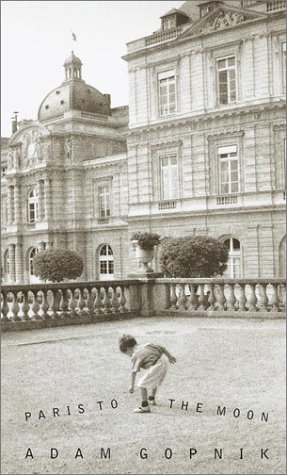
Adam Gopnik has a highly reputation as a journalist of the New Yorker. In 1995, his first child was born in New York, and his wife and him decided that they want to live in Paris in order that their child can have a beautiful existence. The premise is strange. What weird parents would do a thing like that to their child: expatriate him from his family and friends before he can even know them! But whatever, I enjoyed the book. From Paris, during five years, Gopnik will write a column in the New Yorker about topics of his life in France. Paris to the Moon is a compilations of those reports, with four more never handed, and a first chapter (titled as the book) that has been written after.

Gopnik.

It sure is a first narrator who completely knows where he comes from, what he is doing, why he is doing it, and where he will go. What is strange about this book is that even if the narrator is a complete American with his capitalist view of the world and his touristic ways to do things outside his country, he is so full of love for his child, for his wife, for life in itself that it is really difficult to not like his writing. In fact... he is so cheesy. Two examples:

The first is when one of his friend (back in New York, on one of Gopnik visits for Christmas times) asks him why they lives in Paris, Gopnik writes:
"So, Paris. 'We want him [his child] to grow up someplace where everything he sees is beautiful,' we said, and though we realized that the moment our backs were turned our friends' eyes were rolling, we didn't care. We knew that our attempt to insist on a particular set of pleasures for our kid−to impose on our child−might be silly or inappropriate or even doomed. We couldn't help it, entirely. The romance of your child's childhood may be the last romance you can give up."
Isn't it cheesy? Is it gonna work? I mean, is his kid gonna like his life in Paris? Will he take Paris as his home? Or New York? Grown-up, will he find it as romanced as his father had?

The second is that through out his writing he tries to put words on how his country is seen in France and why, but even if he do sees the truth behind some assertions, he just can't bear it. So, to sublime it maybe, he'll gonna transform it in fictions such as comparing Americanism with a T. rex.

Okay, maybe I'm psychoanalyzing Gopnik a little too much, but one thing is sure: this book is refreshing, funny, silly sometimes, but oh-how-really-humane. Even if his aristocratic life deludes him on some aspects of Paris, he nevertheless expresses the will of human being to overcome differences and to enjoy life together.

Paris to the Moon's graphical view given in the book.

I like the way his wife presents their return in New York, concluding the book on a kind of reflexion about what exactly home should be:
"We have a beautiful existence in Paris, but not a full life," Martha said, summing it up, "and in New York, we have a beautiful life and an unbeautiful existence."
Weirdly, I think they're right. You can have only two choices in life: one is to stay right where you are and feel the love and the needs of the ones whom are important for you, the other is to fly where wind brings you, discover and keep on learning about the beauty of diversity. The first one is the easy choice; the second is the difficult controversial one, but that's the one where romance takes place. What do you think?

Just another silly, but so cute moment in his child's childhood in Paris.

Recommended if you want to see Paris through the eyes of an American, if you have a great sense of humor, and if you want to truly know some differences between two cultures that have been at the top of the international economy.

Don't be shy: write a comment! I need to know how you like this post and this blog. Have you read this book? If yes, what were your feelings about it? If not, would you like to?